- Langley Road, Brighton, MA
- 416-402-8274

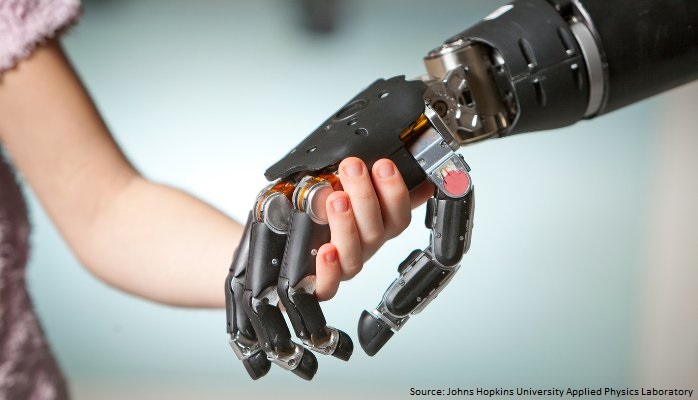
Used to printing paper? Now print cells … and body parts!?
Used to printing paper? Now print cells … and body parts!?
Having lost a hand in a military situation, or in an on-the-job accident, how can we have a personalized replacement hand ‘manufactured’ to match the person’s biology? Then, how will it be delivered to the person and their surgeon as a ‘just-in-time’ solution? Or, have it made-to-order on site?
The hand in the picture above is ‘where we are at’ — today — with robotics. But, here, I’m talking about a real, replacement hand in the future — with skin and bones!
Until recently, bioprinting was not even considered a word in the English language. Bioprinting is the three-dimensional (3D) printing of biological cell patterns (e.g., cells and biomolecules). It works by outputting layer-upon-layer of living cells, which are then fused with advanced additive manufacturing technologies (“bio-ink”) to fabricate make tissues that mimic parts of the body such as the skin or bones. Bioprinting technologies are emerging as a promising 3D ‘biomanufacturing’ technology in medicine.
Bioprinting technologies are increasingly used in biomedicine, and have the potential to:
- Output tissue and organ structures from a culture of a patient’s own cells. The organ that is created is matched to that patient’s individual specifications, and then used to transplant a new organ into their body. This would minimize the risk of transplant organ rejection and the need for life-long immunosuppressant drugs.
- Printing the building blocks, called scaffolds, which can then be used to regenerate joints and ligaments.
- Creating skin for prosthetic (replacement) limbs, or for skin grafts, by taking a few live skin cells and applying the necessary bioengineering to reproduce them.
- Building organs with tumors or other defects so that surgeons could practice on them before entering an operating room.
- Bone tissue engineering — producing artificial bone tissue systems capable of fusing with a patient’s natural bones over time to repair broken or missing bone.
- Speed up and lower the cost of drug development, drug testing and toxicology research by creating artificial tissues and organs. These can take the place of expensive animal and cadaver models that are difficult to obtain.
Bioprinting technologies have moved from basic research in academic laboratories to an emerging industry because of its potential commercial value in applications such as pharmaceutical research on drug dosage forms, delivery, and discovery; skin grafts and transplants; prosthetics and implants; precision medicine and tissue and organ transplantation.
Bioprinting technologies have even made their way into dentistry. Three-dimensional bioprinting technologies are being used to make millions of orthodontic braces, crowns and bridges. There are more than 10 types of 3D bioprinters available to research and development (R&D) users in academic institutions, dentistry and biotechnology & biomedical companies.
There are now 30+ companies worldwide that have a business directly related to 3D bioprinting technologies and bioprinted products. In April 2015, there were about 700 patents and pending applications. That number increased by 36% in June 2016, with more than 950 patents and pending applications. The market size of 3D printing was approximately $2.2 billion in 2012. It is expected to reach $10.8 billion by 2021.
One of the main limitations in bioprinting tissues has been the lack of a sufficient blood vessel system. As a result, the artificial tissues have not been able to adequately maintain a healthy status. Not enough nutrients and oxygen were available to maintain cells or reach far enough into the tissues for the cells to survive.
Researchers have been able to overcome this limitation with the integrated tissue-organ printer (ITOP), an innovative bioprinting system. Now, scientists can produce human-scale tissue and organ examples with the right architecture, and a structure of viable cells held together with “bio-ink”. These cells are engineered with a web of micro-channels to ensure they are well nourished, allowing them to mature and link into the blood supply to obtain energy.
Click Links Below for Information about the SafeTEC™ Consortium to Evaluate New Technologies:
Download HERE to see the List of 15+ Technology Projects, and $3 Million Investment, for SafeTEC.
http://www.onemillionsolutionsinhealth.org/collaborate/safetech/




Connect + Innovate
February 22, 2014 / 0 commentsWhat is Retinol? The Superhero Anti-Aging Ingredient
September 06, 2021 / 0 comments