- Langley Road, Brighton, MA
- 416-402-8274

How to Change the World with 200 People: Organ-On-a-Chip
How to Change the World with 200 People: Organ-On-a-Chip
Last week, roughly 200 people gathered in Boston to discuss the science of Organ-on-a-Chip, Body-on-a-Chip and 3D Cultures … 200 people who will help to change the world! Is this the growth of something as important as the Human Genome Project!?
When and why did the Human Genome Project start?
“In 1986, US scientists held a conference at Santa Fe, New Mexico, where they outlined plans to sequence the entire human genome. There were initially two reasons for this massive undertaking. First, they thought it was the best way to understand the genetic changes that cause cancer. Second, the US Department of Energy needed an efficient way of studying long-term DNA damage caused by radiation – in particular, from the atom bombs dropped on Japan in 1945. The result was the international Human Genome Project, which started in 1990 and was completed in 2003,” according to Science Museum.org
We know that the Human Genome Project has changed the landscape radically, forever! And now we’re going to do the same thing in Organ-on-a-Chip and Regenerative Medicine, by bringing solutions, at scale, to the world’s population.
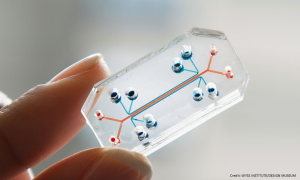
Teams at the Wyss Institute at Harvard, among other teams, are taking translucent, tiny chips, the size of a computer flash drive, and creating the new organs-on-a-chip. In these chips are networks of almost unimaginably tiny tubes, giving this component of the technology its name—micro-fluidics. The chips mimic the structure and function of complete organs because of the micro-fluidics, making them an ideal testbed for pharmaceuticals. Will a new medicine hurt or help the kidney? Let’s find out – by using a replica kidney, rather than a real kidney, or instead of using a mouse’s kidney.
The micro-fluidic cell culture device, created with microchip manufacturing methods, contains continuously-supplied, fluid chambers. These chambers are lined by living human cells which are arranged to simulate tissue- and organ-level physiology and activity. This technology has great prospects to advance the study of how tissues grow, how organs behave, and the course of a particular disease, i.e., tissue development, organ physiology and disease pathology.
Another use for this technology is the opportunity to study and understand the exact molecular mechanisms that cause toxicity in drugs, and also to further enhance biomarker identification. The ultimate goal is to decrease the time and cost for developing new drugs and lessening our dependence on animals as test subjects. When the Harvard team first published its findings on the organ-on-chips in 2010, the research was virtuously scientific. And, now, less than a half a decade later – at least 200 people are seeing the fruits of the Harvard’s labor come into mainstream usage in the industry.
Organs-on-a-Chip embraces the most basic of design principles: efficiency. These new “tools” are finding a role in synthetic biology, recently “bagging” a Design of the Year award!
Why? The chip effectively replaces the 3-D structures of an organ—like the renal tubules (kidney), the alveoli (lungs), the veins (liver)—with these tissue-lined, micro-fluidic channels. Then it matches the mechanics of those structures.
Experts have also commented that these micro-devices could transform personalized medicine, as they would allow researchers to build chips lined with the cells of people from specific genetic groups and learn, in advance, what works for each population of people in the world.
The Harvard team is just one group working in this area. However, they have the funding to build a human, Body-on-a-Chip, with several human organ-on-a-chips linked together on an automated instrument which will mimic the body’s whole physiology. This is the next big goal.
WOULD YOU LIKE TO JOIN US IN THIS EFFORT? Whether you are in science or business, this is your chance to get in on the ground floor. We need to move from 200 people to 20,000 people, to be able to bring this to scale.
The U.S. Federal government is providing $80 million in kick starter funding over the next 7 years to bring together the regenerative medicine, organ-on-a-chip, tissue engineering, cell and organ printing, and tissue biofabrication industries to support a nationwide infrastructure to move ideas out of research and into large-scale production.
What’s in it for YOU (individuals) or YOUR organization? … a source of RESOURCES, plus contacts, connections and potential future business opportunities, as our goal is to OPERATIONALIZE this sector of health care for the US, and beyond.
Anyone from around the world can join in … as long as you will eventually work in the US, hire in the US, or manufacture in the US … anyone from around the world can join!
Click on our website page to find additional background documents on the initiative … http://www.onemillionsolutionsinhealth.org/join-us-for-80-million-grant-application-for-advanced-tissue-biofabrication/
Join our mailing list by signing up HERE
We look forward to having you help us move forward in this new frontier – by taking us from 200 to 20,000 – or more!




Connect + Innovate
February 22, 2014 / 0 commentsWhat is Retinol? The Superhero Anti-Aging Ingredient
September 06, 2021 / 0 comments